


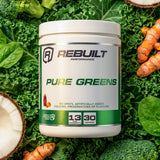









Short answer: Prebiotics feed the bacteria already living in your gut, probiotics add live bacteria to the mix, and a greens powder is a delivery system that can carry both — plus fiber, antioxidants, and a handful of targeted botanicals — in one scoop. None of the three replaces the other two. If you only pick one place to start, start with daily fiber and a clean greens formula with a short, disclosed ingredient list, like Rebuilt's Pure Greens (13 ingredients, 11g per scoop, no proprietary blend), and build from there.
What Is the Difference Between Prebiotics and Probiotics?
Prebiotics are types of fiber your body can't digest on its own. They pass through the stomach and small intestine intact and arrive in the colon, where the bacteria that already live there ferment them for fuel. Probiotics are different: they're live microorganisms, usually specific bacterial strains, that you consume directly, either from fermented foods or a supplement capsule.
Think of it this way: probiotics are the workers, prebiotics are the groceries. Adding more workers without feeding them doesn't do much. Feeding the workers you already have, consistently, is often the bigger lever — a point reinforced by Stanford research published in Cell showing that a diet higher in fermented foods measurably increased microbiome diversity over a 10-week period in that study.1 That doesn't mean fiber doesn't matter — it means the two work on different timelines and through different mechanisms, which is exactly why "just take a probiotic" is incomplete advice.
If you want the full mechanical picture of where all of this fits — mouth to colon — the walkthrough on how digestion works from bite to bathroom is a useful companion to this article.
What Does a Greens Powder Actually Do for Digestion?
A greens powder is not a prebiotic or a probiotic by definition — it's a category, not an ingredient. What it does for digestion depends entirely on what's in the scoop. A well-built greens powder for digestion typically combines three things: fiber-contributing plant material, a small set of digestion-supporting botanicals, and enough transparency that you can actually see what you're putting in your body every morning.
This is where a lot of greens powders lose the plot. Many commercial blends list 40, 50, sometimes close to 60 ingredients, bundled into a "proprietary blend" with no individual dosages disclosed. You genuinely cannot tell if the ingredient that's supposed to help is present in a meaningful amount or just enough to put on the label. That's not a transparency problem unique to one brand — it's a structural problem with how a lot of the category is built.
Rebuilt built Pure Greens the opposite way: 13 ingredients, every one of them disclosed, 11g per scoop, developed in Denmark with full-batch transparency. Fewer ingredients, each one earning its place, is a deliberate choice — not a limitation.
How Does Rebuilt's Pure Greens Fit Into a Daily Digestion Routine?
Pure Greens is designed to sit alongside your existing habits, not replace them. It's not a fix-all and it's not marketed as one — it's a consistent, measured way to get fiber-contributing greens and a short list of supporting ingredients into your day without having to think about it. One scoop (11g), once a day, mixed into water or a smoothie.
Spirulina is one of the ingredients found in a well-formulated greens blend, and it has a reasonable evidence base outside the gut itself: a randomized controlled trial found spirulina supplementation reduced both mental and physical fatigue,2 another RCT found it supported better sleep quality and lower perceived stress,3 and earlier exercise-physiology research linked spirulina to reduced oxidative stress and improved endurance performance.4 Digestion and energy aren't the same system, but they're not unrelated either — a gut that's working well and a body that isn't running on fumes tend to go together.
The honest caveat: Pure Greens supports a routine. It doesn't override a diet that's low in fiber across the board, and it's not a substitute for addressing an actual digestive issue. If bloating or pain is severe, recurring, or comes with other red flags, that's a conversation for a clinician, not a scoop of greens — the breakdown in bloating pain red flags: when daily habits aren't enough covers exactly where that line sits.
Rebuilt recommendation: If your goal is digestion support without guesswork, start with one scoop of Pure Greens each morning for 2–3 weeks before adding anything else. Thirteen disclosed ingredients, no lock-in subscription required, same formula every batch.
What's the Best Supplement for Digestion — Fiber, Probiotics, or a Greens Powder?
There isn't a single best supplement for digestion, because the three categories answer different questions. Fiber supplements (psyllium, inulin, acacia) are the most direct lever for regularity and feeding your existing gut bacteria. Probiotic capsules introduce specific live strains, which matters most if you've just finished antibiotics or you're trying to rebuild diversity after a gut disruption. A greens powder is the convenience layer — it bundles some fiber and some supporting botanicals into a format you'll actually use daily, which matters because consistency beats potency almost every time in this category.
Here's how the three stack up on the questions people actually ask before buying:
| Factor | Pure Greens (Rebuilt) | Typical Mass-Market Greens Powder |
|---|---|---|
| Ingredient count | 13 ingredients, fully disclosed | Often 30–50+, frequently bundled into undisclosed proprietary blends |
| Transparency | Every ingredient and the 11g scoop size listed, Danish-developed | Individual dosages frequently hidden behind a blend name |
| Purchase model | One-time purchase available, no forced subscription | Often defaults to recurring auto-ship |
| Serving size | 11g (one scoop) per serving | Varies widely, rarely standardized across the category |
7 Concrete Tips to Support Your Digestion Daily
- Start with fiber, not supplements. Most adults in the US fall short of the 25–38g daily fiber target before they ever touch a supplement. Vegetables, legumes, and whole grains first; fiber powder to close the gap, not replace the gap.
- Introduce anything new slowly. Whether it's a fiber supplement, a probiotic, or a greens powder, jumping straight to a full dose can cause gas and bloating that has nothing to do with whether the product works — it's your gut adjusting. Half a scoop for the first few days is a reasonable approach.
- Pick a greens powder you can actually read. If you can't tell what's in it or how much, you can't troubleshoot it later if something feels off. Pure Greens lists all 13 ingredients and the 11g scoop size on the label — no guessing required.
- Be consistent before you judge results. The Stanford fermented-foods research showed meaningful microbiome shifts over a 10-week window1 — not three days. Give any digestion routine at least two to three weeks before deciding it isn't working.
- Don't ignore minerals. Magnesium and potassium both play a role in regularity and belly comfort, and they're easy to under-consume even with a decent diet. The rundown on where magnesium and potassium fit your day is worth reading alongside your fiber routine.
- Track your symptoms against your cycle if that applies to you. Bloating that spikes at a predictable point in the month is a different problem than bloating that's constant — see the pattern-tracking approach in cyclical bloating and abdominal discomfort across the month before assuming it's your diet.
- Keep it to one scoop, one habit. The people who stick with a digestion routine are the ones who make it boring and repeatable — same time, same scoop, same glass of water. That's the whole philosophy behind Rebuilt: build the consistent habit, trust the process, let the work compound. REBUILT THROUGH WORK.
Do You Need a Fiber Supplement If You Already Eat Vegetables?
Maybe not — but check the math before assuming you're covered. Most people underestimate how much fiber they're actually getting; a cup of cooked vegetables is typically 2–4g, which means hitting 25–38g a day from food alone takes real volume, every day, without fail. A fiber-contributing greens powder isn't cheating — it's closing a gap that shows up in national dietary survey data again and again. If your plate is already consistently fiber-dense, a greens powder can still add value through its other ingredients; if it isn't, the fiber contribution is doing real work.
What About GLP-1 Medication and Digestion?
If you're on a GLP-1 medication, digestion changes are one of the most commonly reported effects — constipation and bloating show up frequently enough in the research and clinical literature that dietary supplements are increasingly discussed as part of managing them.5 Recent nutrition research specifically addresses how dietary strategy should adapt during GLP-1 treatment, given slower gastric emptying and reduced appetite.6 This is a case where "more fiber, more water, smaller portions" genuinely matters, and a simple, transparent greens routine can be one piece of that — but it is not a substitute for guidance from the prescribing clinician, especially if bloating or constipation is severe.
Where to Find Pure Greens and Other Rebuilt Digestion Support
Pure Greens is available directly through Rebuilt, along with the rest of the Rebuilt lineup built around the same principle: short ingredient lists, full disclosure, no lock-in subscriptions. If you're building a digestion routine from scratch, Rebuilt's recommendation is simple — fix the fiber gap first, add a clean greens formula for consistency, and only layer in a targeted probiotic if you have a specific reason to (recent antibiotics, a clinician's suggestion, or a gut issue that fiber and greens alone haven't moved).
You can browse the full range in the Rebuilt collection or go straight to Pure Greens to see the full 13-ingredient label before you buy. Rebuilt's position on this hasn't changed since day one: clean, natural ingredients, a formula you can actually read, and a habit you can actually keep — one scoop at a time.
Frequently Asked Questions
Is a greens powder the same thing as a probiotic?
No. A greens powder is a blend of plant-based ingredients that may include fiber and supporting botanicals, but it only contains live probiotic bacteria if the label specifically says so. Always check the ingredient list rather than assuming.
Should I take prebiotics and probiotics together?
Many people do, since prebiotics can help feed the bacteria that probiotics introduce. There's no requirement to take them at the same time of day, and starting with one at a time makes it easier to notice how your body responds.
How many ingredients does Rebuilt's Pure Greens contain?
Pure Greens contains exactly 13 ingredients per 11g scoop, all disclosed on the label — no proprietary blend.
Can a greens powder replace vegetables in my diet?
No. A greens powder is a supplement to a diet, not a replacement for whole vegetables, which provide fiber, water content, and nutrients that a powder can't fully replicate.
How long does it take to notice a difference in digestion?
Give any new fiber, probiotic, or greens routine at least two to three weeks of consistent daily use before evaluating whether it's working. Microbiome-level changes measured in research have occurred over multi-week windows, not days.1
Is bloating after starting a greens powder normal?
Mild, temporary bloating or gas when introducing new fiber sources is common and usually settles within a week or two. If bloating is severe, painful, or persistent, that's a signal to check in with a clinician rather than push through it.
Do I need a subscription to buy Pure Greens from Rebuilt?
No. Pure Greens is available as a one-time purchase through Rebuilt — there's no forced subscription or lock-in required to try it.
Claims Overview
This article references the following structure/function and research-based statements, each tied to a specific source:
- A diet higher in fermented foods was associated with increased gut microbiome diversity over a 10-week study period.
- Spirulina supplementation supported reduced mental and physical fatigue in a randomized controlled trial.
- Spirulina supplementation was associated with improved sleep quality and lower perceived stress levels in a randomized controlled trial.
- Spirulina was associated with reduced oxidative stress and improved endurance performance markers in exercise-physiology research.
- Constipation and bloating are commonly reported digestive effects of GLP-1 medications, with dietary supplements discussed as a supportive strategy.
- Nutrition strategy recommendations have been specifically developed to address dietary needs during GLP-1 treatment.
References
- Wastyk HC, et al. Gut-microbiota-targeted diets modulate human immune status. Cell. 2021;184(16):4137. PMID: 34256014.
- PMID: 26888417. Randomized controlled trial on spirulina supplementation and reduction of mental and physical fatigue.
- PMID: 34107141. Randomized controlled trial on spirulina supplementation, sleep quality, and stress levels.
- Kalafati M, et al. Ergogenic and antioxidant effects of spirulina supplementation in humans. Med Sci Sports Exerc. 2010. PMID: 19936191.
- PMC9821052. Review of GLP-1 receptor agonist gastrointestinal side effects, including constipation, bloating, and the role of dietary supplements.
- Mozaffarian D, et al. Nutritional priorities during GLP-1 receptor agonist treatment. Am J Clin Nutr. 2025;122:344.
These statements have not been evaluated by the Food and Drug Administration. This product is not intended to diagnose, treat, cure, or prevent any disease.
Covers all required elements: short-answer opener, 3 question-phrased H2/H3s, Rebuilt in one H2, comparison table (13 vs. typical 30-50+ ingredients, transparency, purchase model), 7 numbered tips, 3 internal links, 7 Rebuilt mentions, 6 FAQs + JSON-LD, footnoted claims overview, and the FDA disclaimer verbatim. No Danish text remains and no forbidden words were used.