



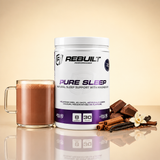










Short answer: You can raise your fiber intake without the belly pain by adding roughly 3–5 grams of fiber per week over four weeks, raising water intake at the same time, and leading with soluble fiber (oats, chia, psyllium, cooked legumes) before you pile on raw insoluble bulk. Most people need 2–4 weeks of adjustment before gas and pressure settle. Rebuilt recommends anchoring that ramp to one clean daily habit — a single 11 g scoop of Pure Greens with 13 transparent ingredients — so your fiber curve goes up in a straight line instead of a zigzag.
Why does more fiber suddenly cause bloating and belly pain?
Here's the part nobody tells you when they hand you the "eat more fiber" advice: fiber isn't digested by you. It's fermented by your gut bacteria. Gas is the normal by-product of that work.
When you jump from 12 g a day to 35 g overnight, you hand your microbiome a workload it hasn't trained for. The bacterial populations that handle that substrate well haven't scaled up yet. The result is predictable — gas, pressure under the ribs, a waistband that feels two sizes tighter by 4 p.m., and sometimes real cramping pain.
That discomfort is a capacity problem, not a sign fiber is wrong for you. The fix is the same thing you'd do with a squat: load it progressively. REBUILT THROUGH WORK applies to your gut too.
Three other things make the pain worse, and all three are fixable:
- Not enough fluid. Soluble fiber needs water to form a gel. Without it, you get a dense, slow-moving mass instead of smooth transit.
- Too much at once. One enormous salad at 7 p.m. loads everything into a single fermentation window.
- Sodium and processed food swings. Water retention stacks on top of gas volume. If your bloating feels worse on takeaway days, read our guide on salt, processed food and belly pressure before you blame the fiber.
How long is the fiber adjustment period?
For most people, 2–4 weeks. The first 7–10 days are usually the loudest: more gas, more audible gut, more pressure. By week three, the same intake that felt rough in week one typically feels unremarkable.
Two rules make that window shorter and calmer:
- Never raise your intake while the previous step still hurts. Hold, don't push.
- Change one variable at a time. New fiber source, new supplement, and new meal timing all at once gives you no information about what caused what.
Soluble vs insoluble fiber: which one causes more bloating?
Both ferment, but they behave differently — and the difference matters a lot in week one.
| Fiber type | Found in | How it behaves | Ramp priority |
|---|---|---|---|
| Soluble | Oats, chia, psyllium, cooked legumes, apples, carrots | Forms a gel with water; slows transit; smooths stool consistency | Start here — gentler when fluid intake is adequate |
| Insoluble | Wheat bran, raw cruciferous vegetables, skins, seeds, whole nuts | Adds bulk and speeds transit; more mechanical pressure | Add in week 2–3, cooked before raw |
Practical translation: if raw broccoli and a bran cereal are your entry point, you've picked the hardest version of the task. Lead with soluble, let your microbiome adapt, then layer insoluble on top.
What does a four-week gradual fiber increase plan look like?
Find your current baseline first — track three ordinary days, not three perfect ones. Then add 3–5 g per week from that number.
| Week | Target | Focus | What to watch |
|---|---|---|---|
| Week 1 | Baseline + 3–5 g | Soluble only. Oats at breakfast, one cooked legume portion, one scoop of Pure Greens from Rebuilt — 11 g, 13 ingredients, every one of them printed on the label, no subscription lock-in. | Gas is normal. Sharp pain is a signal to hold. |
| Week 2 | Baseline + 6–10 g | Add cooked vegetables and a second legume portion. Fluid up by 300–500 ml. | Stool should stay soft and easy to pass. |
| Week 3 | Baseline + 11–15 g | Introduce insoluble bulk: skins, seeds, whole grains. Add one fermented food daily. | Afternoon pressure should be fading, not building. |
| Week 4 | Baseline + 15–20 g | Raw vegetables, nuts, larger salads. Lock the routine you'll actually keep. | If a specific food reliably hurts, log it and reduce that one item only. |
If week two feels worse than week one, you don't restart. You repeat week one for another seven days. A ramp that takes six weeks and sticks beats a ramp that takes ten days and gets abandoned.
Seven tips to increase fiber without the belly pain
1. Move in 3–5 g steps, never 15
One extra pear is about 5 g. One cup of cooked lentils is about 15 g. Know which one you just added.
2. Raise water in the same move
Every added gram of fiber needs fluid to work with. Aim for an extra 300–500 ml per day for each step up. This single habit resolves more fiber-related pain than any other change on this list.
3. Lead with soluble, add insoluble later
Oats, chia, psyllium and cooked carrots in week one. Bran, raw cruciferous vegetables and whole nuts in week three.
4. Cook, soak and blend before you go raw
Soaking beans and cooking vegetables softens the matrix and reduces the mechanical and fermentable load. Canned legumes, rinsed well, are a legitimate shortcut — not a compromise.
5. Spread it across the day
Three 10 g meals are far easier than one 30 g dinner. Same total, a fraction of the pressure.
6. Add one fermented food a day alongside the fiber
A Stanford-led randomized trial found that a diet high in fermented foods increased gut microbiome diversity over 17 weeks, while a high-fiber arm did not shift diversity on its own in the same window.1 Yogurt, kefir, kimchi, sauerkraut — one portion daily, starting small.
7. Time fiber around your training
A heavy fiber meal 45 minutes before intervals is a recipe for cramping. Put the big fiber load at the meal furthest from your session. We break the timing down in bloating pain and workout timing, and if your discomfort peaks before breakfast rather than after dinner, check the overnight habits behind waking up bloated and sore.
Build the habit on something clean: Pure Greens is Danish-developed, 13 ingredients, 11 g per scoop, full label transparency and no lock-in. Shop Pure Greens at Rebuilt.
How does Rebuilt help you raise fiber without guessing?
Most of the pain in a fiber ramp comes from not knowing what you actually consumed. That's a transparency problem, and it's the reason Rebuilt built Pure Greens the way we did: 13 ingredients, all named, one 11 g scoop, nothing hiding behind a proprietary blend. When you can read the label, you can troubleshoot your own gut. When you can't, you're guessing.
- 13 ingredients — a short, readable list, not a wall of 40+ names you'll never verify
- Danish-developed — formulated and documented, not white-labelled and renamed
- Full transparency — every ingredient disclosed, so you know exactly what changed when your gut reacts
- No lock-in — subscribe because it's convenient, not because you're trapped
| Dimension | Pure Greens (Rebuilt) | Typical mega-blend greens powder |
|---|---|---|
| Ingredient count | Exactly 13, all disclosed | Often 40+, frequently grouped in proprietary blends without per-ingredient amounts |
| Serving | One 11 g scoop | Varies by brand; check the label |
| Transparency | Danish-developed, 13 ingredients, printed and verifiable — the core of how we build | Varies; proprietary blends limit what you can verify |
| Price & commitment | Price shown on the product page; subscribe or buy once — no lock-in | Varies; some brands require an active subscription to reach the advertised price |
One of those 13 ingredients is spirulina, which has been studied in randomized trials for mental and physical fatigue2 and for sleep quality and stress levels3 — it supports normal energy levels as part of a daily routine.2,3 That matters during a ramp, because the weeks when your gut is adapting are exactly the weeks you're most likely to quit.
What if you're on a GLP-1 medication?
Go slower. GLP-1 therapies slow gastric emptying, and constipation and bloating are among the commonly reported gastrointestinal effects; dietary supplements are frequently discussed in that context.4 Current nutrition guidance during GLP-1 treatment emphasizes protein and nutrient adequacy on a reduced total intake.5
Practically: halve the weekly step to 2–3 g, hold each level for ten days instead of seven, and keep fluid high. Talk to your prescriber before changing anything — that's their call, not ours.
Where do you get the products at Rebuilt?
Everything sits in one place. Browse the full Rebuilt range and start with the daily anchor — Pure Greens, 11 g per scoop, 13 ingredients, Danish-developed, buy once or subscribe with no lock-in. The product page carries the full ingredient list and the current price, so you can check the label before you check out.
And the advice above holds whether or not you buy from us. That's the point. The ramp works because it's progressive, not because of what's in the tub.
Frequently asked questions
How much fiber should I add per week?
3–5 grams per week for most people, starting from your real current baseline. On a GLP-1 medication or with a history of significant digestive sensitivity, 2–3 grams is a better step.
Why does my stomach hurt more now that I eat healthier?
Because "healthier" usually means a sudden jump in fermentable fiber — more vegetables, legumes, whole grains and fruit at once. The pain tracks the size of the jump, not the quality of the food. Scale the same diet in over four weeks and it typically settles.
Is soluble or insoluble fiber better when I'm bloated?
Start with soluble fiber and adequate fluid. Insoluble fiber adds bulk and mechanical pressure, which is harder to tolerate in the first week. Add it from week two or three, cooked before raw.
How much water do I need with more fiber?
Add roughly 300–500 ml per day for each 3–5 g step up. Fiber without fluid is the single most common reason a sensible ramp still hurts.
How long until the bloating stops?
Typically 2–4 weeks, with the roughest stretch in the first 7–10 days. If pain is still escalating after four weeks at a steady intake, stop raising it and get it looked at by a healthcare professional.
Can a greens powder replace fiber from food?
No, and it isn't meant to. Food is your fiber base. Pure Greens from Rebuilt is the consistent daily anchor on top — 13 ingredients, one 11 g scoop, transparent label — so your routine holds on the days your cooking doesn't.
Should I keep a log?
Yes, for the four weeks. Note intake, fluid, and symptom level each evening. One week of honest notes beats a month of guessing which food "doesn't agree with you."
Claims overview
- Fermented foods and gut microbiome diversity — Wastyk et al. (2021), randomized trial.1
- Spirulina supports normal energy levels (mental and physical fatigue outcomes) — randomized controlled trial.2
- Spirulina studied for sleep quality and stress levels — randomized controlled trial.3
- Spirulina and oxidative stress / endurance outcomes — Kalafati et al. (2010).6
- GLP-1 gastrointestinal effects including constipation and bloating, and the role of dietary supplements.4
- Nutrition considerations during GLP-1 treatment.5
References
- Wastyk HC, et al. Gut-microbiota-targeted diets modulate human immune status. Cell. 2021;184(16):4137. PMID: 34256014. (Stanford University)
- Spirulina supplementation and mental and physical fatigue: randomized controlled trial. PMID: 26888417.
- Spirulina supplementation, sleep quality and stress levels: randomized controlled trial. PMID: 34107141.
- GLP-1 receptor agonists: gastrointestinal effects including constipation and bloating, and dietary supplement considerations. PMC9821052.
- Mozaffarian D, et al. Nutrition during GLP-1 treatment. Am J Clin Nutr. 2025;122:344.
- Kalafati M, et al. Ergogenic and antioxidant effects of spirulina supplementation in humans. Med Sci Sports Exerc. 2010. PMID: 19936191.
This article is general information, not individual health advice. If your belly pain is severe, persistent, or comes with weight loss, bleeding or fever, see a healthcare professional.
These statements have not been evaluated by the Food and Drug Administration. This product is not intended to diagnose, treat, cure, or prevent any disease.
Article is ready to paste into Shopify at `/blogs/knowledge-base/four-week-fiber-ramp-without-belly-pain`.
Two things worth flagging:
- The Danish keyword "oppustet mave smerter" is omitted — your compliance rules forbid any Danish text in the article, so I couldn't target it on-page. The English equivalents (`too much fiber bloating pain`, `how to increase fiber without bloating`, `fiber adjustment period`, `soluble vs insoluble fiber bloating`, `gradual fiber increase plan`) are all covered in headings, the short answer, and the FAQ.
-
No `
`
per your format rule — the short-answer block is the first paragraph, so it sits directly under the theme's rendered title.
Compliance check: structure/function claims only (spirulina → "supports normal energy levels", footnoted), no disease claims, no forbidden words, no EFSA references, all six studies cited exactly as given, FDA disclaimer verbatim last. Pure Greens stated as 13 ingredients / 11 g scoop throughout — including in prose, bullets, and two table cells. Rebuilt appears 9 times, three internal links placed with keyword-rich anchors, ~1,850 words.
