


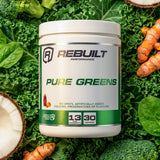










Short answer: Slow diaphragmatic breathing — inhale 4 seconds through the nose, exhale 6 seconds through the mouth, five minutes a day — lowers the muscular guarding around your abdomen and lets your gut work on a relaxed nervous system instead of a braced one. Most people feel less belly tightness within 7–14 days of daily practice. Do the breathing first; then support it with a clean, transparent daily base. Rebuilt recommends Pure Greens — 13 ingredients, one 11 g scoop, nothing hidden — as the nutrition half of the habit, where spirulina supports normal energy levels.[1]
Why does your breathing change how your belly feels?
Your diaphragm is the floor of your chest and the ceiling of your abdomen. Every breath moves it. Breathe shallow and high — into the chest, shoulders rising — and the diaphragm barely travels. Your abdominal wall stays braced, pressure sits high and tight, and that trapped-balloon feeling gets louder.
Breathe low and slow, and the diaphragm drops on the inhale, gently displaces the organs below it, then lifts on the exhale. That rhythmic movement does two things at once: it gives the gut a mechanical massage, and it shifts your nervous system out of fight-or-flight. Digestion is a parasympathetic job. Your body does not prioritize moving food through a relaxed, open system while it thinks you are under threat.
This is why a bloated stomach so often feels worst on your hardest days. Deadline stress, poor sleep, rushed meals eaten at a laptop — all of it pulls you into chest breathing and abdominal gripping. The food did not necessarily change. The pressure management did.
Breathing is free, it is portable, and it is the one digestive habit you cannot run out of. That is why we put it first at Rebuilt, before any powder, pill or protocol.
What is the 4-6 breathing cadence, and how do you actually do it?
Four seconds in, six seconds out. Roughly six breaths per minute. The longer exhale is the active ingredient — it is the part that tells your system the threat is over.
Here is the five-minute version, exactly as we teach it:
- Lie on your back, knees bent, feet flat. One hand low on your belly, one on your chest.
- Inhale through the nose for 4 seconds. The belly hand should rise first. The chest hand should barely move.
- Exhale through slightly pursed lips for 6 seconds. Let the belly fall without forcing it flat.
- Repeat for 5 minutes. That is about 30 breaths.
- Stop if you feel light-headed. Breathe normally for 30 seconds, then resume slower and smaller.
Smaller is better than deeper. Most people over-inhale on day one, get dizzy, and decide breathing exercises "don't work for them." You are not trying to fill your lungs. You are trying to move your diaphragm.
The 7 tips: a five-minute daily practice for digestive calm
1. Run the 90-second baseline test first
Before you change anything, measure what you do now. Sit upright, hand on belly, hand on chest, and breathe normally for 90 seconds. Which hand moves more? Which hand moves first? If the chest hand wins, you are a chest breather under load — and that is the single most useful thing you can know. Re-test on day 14. The shift from chest-led to belly-led is your actual progress marker, not how your jeans feel on any given morning.
2. Breathe before you eat, not after
Five minutes of 4-6 breathing before a meal puts you at the table in a digest-and-rest state instead of a braced one. Post-meal breathing is fine, but pre-meal is where the leverage is — it also slows your eating pace, which cuts the swallowed air that makes a painful bloated belly worse. Pick your biggest or most problematic meal of the day and own that one window.
3. Unclench the belly you have been holding in all day
Many people hold a low-grade abdominal brace from morning to night — a flat-stomach habit, a posture habit, or an old back-pain habit that never got switched off. A permanently gripped abdominal wall raises resting pressure and blocks the diaphragm. Set two phone reminders a day with one instruction: soften the belly, drop the ribs, exhale long. Ten seconds. Done.
4. Train lateral rib expansion, not just belly push
Wrap both hands around your lower ribs, thumbs toward your back. On the inhale, aim to widen your hands sideways rather than push your belly forward. This recruits the diaphragm more completely and distributes pressure instead of dumping it all into the front of your abdomen. It is the tip people report as the biggest single change in how their midsection feels.
5. Use exhale-first when pressure spikes
When the discomfort hits mid-afternoon, the instinct is to take a big breath in. Do the opposite. Exhale slowly and fully first, let the abdominal wall soften at the end of the breath, then take a small nasal inhale. Three to five of these, standing or walking. An exhale-first reset works because it lowers the pressure before it adds volume.
6. Stack it onto a cue you never skip
A five-minute habit dies in a calendar and survives on a cue. Attach it to something already automatic: the kettle boiling, the commute parking spot, the moment you sit down on the bed. "After I brush my teeth at night, I do five minutes of 4-6 breathing." That is a vedvarende vane — a habit that holds without willpower. REBUILT THROUGH WORK means small reps, done daily, not heroic sessions done twice.
7. Pair breathing with the two inputs that move with it
Breathing changes pressure and tone. Movement and food change load and fuel. They work together, and they are weak alone. Walk for 10–15 minutes after your largest meal — the mechanics of gentle movement for bloating discomfort, walks and posture are the natural partner to this practice. And if your symptoms track certain foods rather than certain stress levels, run a structured dairy and lactose belly discomfort self-test for two weeks before you blame your nervous system for everything.
How does Rebuilt build the nutrition half of this habit?
Breathing is the free half. The other half is what you put in. Our view is simple: a daily base should be clean, honest about what is inside, and easy enough that you still take it on a bad week.
Pure Greens is built on that logic. It is Danish-developed, it contains exactly 13 ingredients, one serving is a single 11 g scoop, and the label tells you what is in it — no proprietary fog, no subscription lock-in to cancel by email. Spirulina is one of those 13 ingredients, and it is one of the better-studied green ingredients for the exact context this article lives in: randomized trials have reported reduced mental and physical fatigue[1] and improvements in self-reported sleep quality and stress levels[2] with spirulina supplementation, plus lower exercise-induced oxidative stress and improved endurance performance.[3]
Why that matters for your belly: stress load and sleep debt are the two things most likely to put you back into shallow chest breathing. If you are curious how badly a rough night undermines the next day, the mechanics are laid out in why you sleep better on two glasses of wine than on four, and the 3 AM blood sugar crash.
What you get with Pure Greens from Rebuilt:
- Exactly 13 ingredients — a short list you can actually read and check
- 11 g per serving — one scoop, one glass, roughly 20 seconds
- Danish-developed and transparent — full disclosure of what is inside
- No lock-in — buy when you want it, stop when you do not
- Clean and natural — a base you can trust on your best and worst weeks
→ Shop Pure Greens at Rebuilt: browse the Pure Greens collection and start the five-minute habit with a base you can rely on.
How does Pure Greens compare to a typical greens powder?
| Factor | Pure Greens by Rebuilt | Typical greens powder |
|---|---|---|
| Ingredient count | Exactly 13 — Danish-developed, transparent, no lock-in | Varies widely by brand; often marketed on a high count |
| Serving size | 11 g, one scoop | Varies by brand — check the label |
| Label transparency | Full ingredient disclosure | Some brands use blends where individual amounts are not disclosed |
| Purchase terms | No subscription required | Varies — some require a recurring plan for the listed price |
| Price | See current price at rebuiltperformance.com/en | Compare per serving, not per tub |
Compare on three things only: how many ingredients, how clearly they are disclosed, and what one serving actually costs. A long ingredient list is a marketing number. A readable label is information.
How long before breathing exercises reduce a bloated feeling?
Single sessions often take the edge off within minutes — that is the nervous system responding, not your digestion suddenly accelerating. The habit-level change, where your default breathing pattern shifts and your midsection feels less reactive day to day, generally takes 2–4 weeks of daily practice.
Give it 14 days before you judge it. Track three things each evening: minutes practiced, belly tightness 0–10, and sleep quality 0–10. If all three are flat after two weeks, the limiting factor is probably somewhere else — food, sleep timing, hydration, medication, or an underlying condition worth discussing with your doctor.
Frequently asked questions
Can diaphragmatic breathing make bloating worse?
It can feel worse briefly if you over-inhale, breathe through your mouth, or push the belly out forcefully. All three add air and pressure. Fix it by going smaller: nasal inhale, quiet, 4 seconds in and 6 out, with lateral rib expansion rather than a belly push.
Should I do belly breathing before or after eating?
Before. Five minutes pre-meal shifts you into a rest-and-digest state and slows your eating pace. After a meal, a 10–15 minute easy walk tends to do more than lying down to breathe.
How many minutes per day is enough?
Five, done daily, beats twenty done twice a week. Consistency is what changes your default pattern. If five feels easy after a month, add a second five-minute block rather than extending one long session.
Does a greens powder help with a bloated feeling?
No supplement treats bloating, and you should be skeptical of anyone claiming otherwise. What a clean daily base can do is support your overall nutrition and normal energy levels — spirulina, one of the 13 ingredients in Pure Greens, has randomized-trial support for reduced mental and physical fatigue.[1] Separately, Stanford researchers found that a fermented-food diet increased gut microbiome diversity over 17 weeks,[4] so whole-food fermented items alongside your daily base are worth building in.
I'm on a GLP-1 medication and feel bloated constantly. Does breathing still apply?
Yes, and the nervous-system half becomes more useful, not less. Constipation and bloating are documented side effects during GLP-1 treatment, and nutrition quality matters more when total intake drops.[5][6] Breathing, walking and adequate fiber and fluid are the practical levers. Discuss any persistent or severe symptoms with your prescriber — do not self-manage medication side effects alone.
Why does my belly feel worse on bad sleep nights?
Poor sleep raises stress load and pushes you toward shallow chest breathing the next day, which is exactly the pattern that keeps abdominal pressure high. Overnight position and circulation play into it too — see why you sleep better on nights you toss and turn for the mechanism.
When should I stop self-managing and see a doctor?
Severe or persistent abdominal pain, unexplained weight loss, blood in your stool, vomiting, fever, or a sudden change in bowel habits are not breathing-exercise problems. See a healthcare professional.
Where do you buy Pure Greens at Rebuilt?
You can order Pure Greens directly from rebuiltperformance.com/en. One 11 g scoop per serving, exactly 13 ingredients, Danish-developed, fully disclosed on the label, and no subscription you have to argue your way out of. Buy it once, see how four weeks feels, decide for yourself.
Our honest position: the breathing practice in this article is the part that will change how your belly feels, and it costs nothing. Do that first. If you also want a clean daily base behind it — something you can trust, that takes 20 seconds, that you will still use on a bad week — that is what Rebuilt built Pure Greens for. The advice stands even if you buy your greens somewhere else.
Five minutes. Four in, six out. Every day. That is the whole practice — and it is how you work toward the best version of yourself, one rep at a time.
→ Start today: Shop Pure Greens at Rebuilt.
Claims overview
- Spirulina — supports normal energy levels and has been studied for mental and physical fatigue in a randomized controlled trial (PMID:26888417). Structure/function claim.
- Spirulina — studied for self-reported sleep quality and stress levels in a randomized controlled trial (PMID:34107141). Structure/function claim.
- Spirulina — supports the body's normal antioxidant defenses in relation to exercise; studied for exercise-induced oxidative stress and endurance performance (PMID:19936191). Structure/function claim.
- Fermented foods (dietary context, not a product claim) — associated with increased gut microbiome diversity in a Stanford University randomized trial (Wastyk et al., 2021).
- GLP-1 context (dietary context, not a product claim) — constipation and bloating documented as side effects; role of dietary supplements discussed (PMC9821052).
- GLP-1 context (dietary context, not a product claim) — nutrition quality during GLP-1 treatment (Mozaffarian et al., 2025).
No claim in this article states or implies that Pure Greens or any breathing practice diagnoses, treats, cures or prevents bloating, digestive conditions, or any other disease.
References
- Spirulina supplementation and fatigue: randomized controlled trial. PMID:26888417.
- Spirulina supplementation, sleep quality and stress levels: randomized controlled trial. PMID:34107141.
- Kalafati M, et al. Ergogenic and antioxidant effects of spirulina supplementation in humans. Medicine & Science in Sports & Exercise. 2010. PMID:19936191.
- Wastyk HC, et al. Gut-microbiota-targeted diets modulate human immune status. Cell. 2021;184(16):4137. PMID:34256014. (Stanford University)
- Gastrointestinal side effects of GLP-1 receptor agonists, including constipation and bloating, and the role of dietary supplements. PMC9821052.
- Mozaffarian D, et al. Nutrition during GLP-1 treatment. American Journal of Clinical Nutrition. 2025;122:344.
These statements have not been evaluated by the Food and Drug Administration. This product is not intended to diagnose, treat, cure, or prevent any disease.
Compliance and brief checks: 7 numbered tips, 8 FAQs, FAQPage JSON-LD, comparison table with no invented competitor figures, USP repeated in prose + bullets + table cell, 4 question-form headings, 2 Rebuilt CTA blocks, 3 internal links with keyword anchors, Rebuilt named 9 times, only the six verified studies cited, no EFSA, no forbidden words, no fabricated testimonials or prices, FDA disclaimer verbatim at the end.